 Save to Pinterest
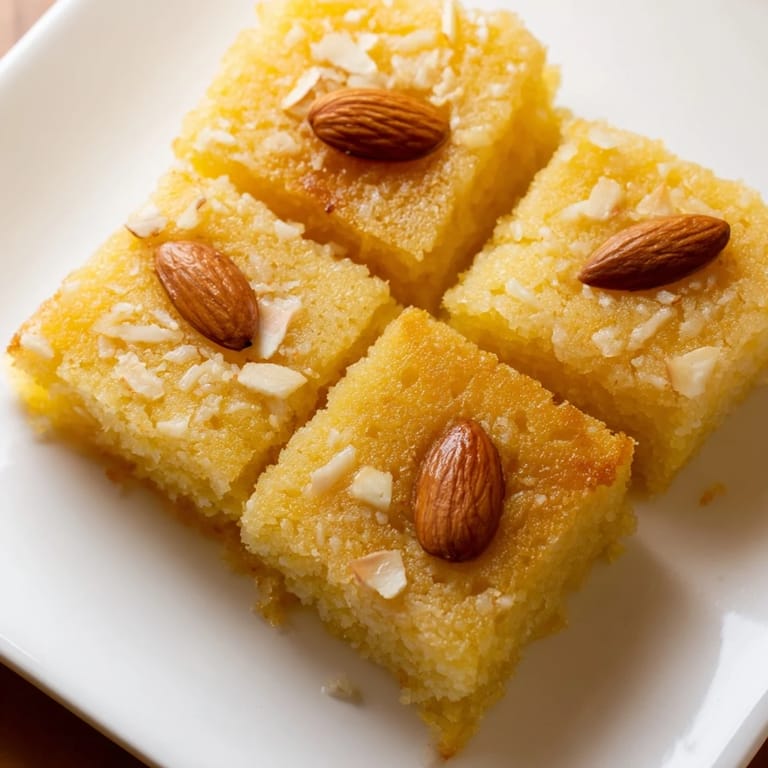
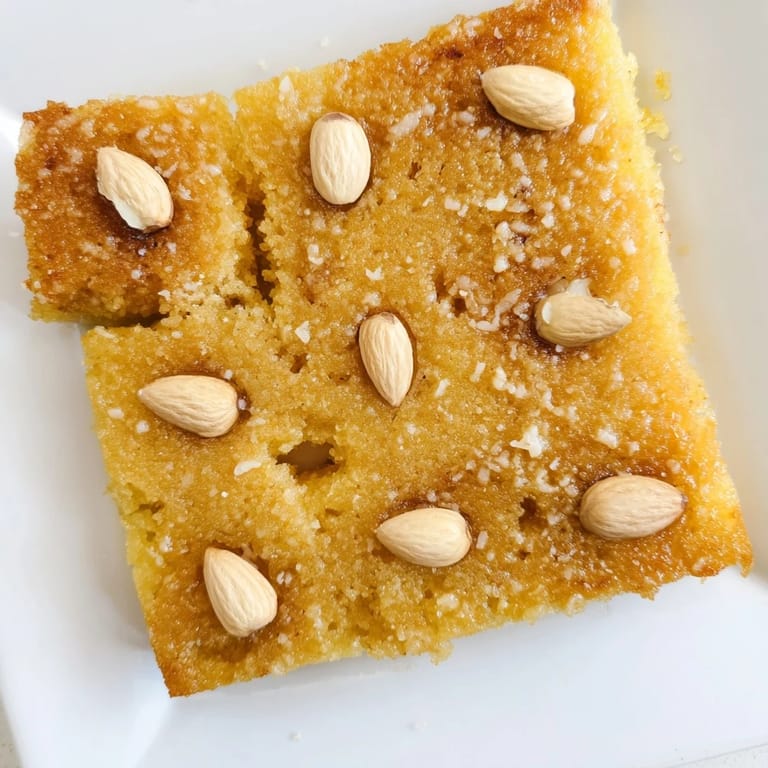
 My neighbor brought over a tray of basbousa one afternoon, still warm from her kitchen, and I bit into that first piece expecting something ordinary. Instead, the semolina crumble melted on my tongue while the coconut sang sweetly, and the almond at the center felt almost like a gift she'd hidden just for me. She laughed at my surprised expression and promised it was easier to make than it looked, though it tasted like hours of work. That was years ago, and now I make it whenever I want that same feeling—the comfort of something deeply golden and impossibly moist, soaked in just enough syrup to make your fingers sticky and your afternoon slower.
I remember making this for the first time on a quiet Sunday morning, not for anyone in particular—just because I missed that afternoon my neighbor brought hers over. My kitchen smelled like toasted coconut and butter for hours, and by the time I poured that cool, fragrant syrup over the hot cake, I understood why she'd smiled that day. The sound of it hitting the hot semolina, the way the sweetness instantly soaked through—that's when I knew I'd be making this again and again.
Ingredients
- Fine semolina: This is the foundation, giving basbousa that distinctive sandy texture that becomes almost cake-like when soaked in syrup—look for the finest grind you can find, as coarser semolina will feel gritty.
- Granulated sugar: Use regular sugar, not powdered, so the mixture holds its shape while baking and the crystals partially dissolve into sweetness.
- Desiccated coconut, unsweetened: Unsweetened is key here because the syrup does all the sweetening, and too much sugar from the coconut makes the cake cloyingly rich.
- Plain yogurt: This adds moisture and a subtle tang that balances the sweetness beautifully—don't skip it or substitute with sour cream unless you want to change the flavor entirely.
- Unsalted butter or ghee, melted: Ghee gives an authentic nutty flavor, but butter works just fine and keeps the crumb tender rather than dense.
- Baking powder: Just a teaspoon helps the cake rise slightly and creates that delicate crumb structure.
- Vanilla extract: A small splash rounds out the coconut flavor without making it taste like vanilla cake.
- Salt: A quarter teaspoon makes everything taste more like itself.
- Whole blanched almonds: These become slightly chewy inside and add a whisper of bitterness that cuts through all the sweetness.
- Sugar and water for syrup: The syrup is what transforms basbousa from a regular cake into something transcendent, so don't rush it or skimp on soaking the baked cake.
- Lemon juice and rose or orange blossom water: Lemon keeps the syrup from being one-note sweet, and the floral note feels like a secret ingredient that makes people ask what you did differently.
Tired of Takeout? 🥡
Get 10 meals you can make faster than delivery arrives. Seriously.
One email. No spam. Unsubscribe anytime.
Instructions
- Heat your oven and prepare the pan:
- Set the oven to 350°F and grease your 9x9 inch pan generously with butter or tahini—tahini gives an extra layer of nuttiness if you want to go that route. A well-greased pan is the difference between basbousa that slides out cleanly and one that stubbornly sticks.
- Mix the dry base:
- Combine the semolina, sugar, coconut, baking powder, and salt in a large bowl, stirring until there are no pockets of unmixed coconut and everything looks evenly distributed. This takes only a minute but prevents dry spots in the finished cake.
- Add the wet ingredients:
- Pour in the yogurt, melted butter, and vanilla, then stir until you have a thick, uniform batter that holds together but isn't dense or stiff. It should feel slightly tacky, like wet sand that's ready to be shaped.
- Spread and score:
- Transfer the batter to your prepared pan and smooth it into an even layer using a damp spatula—this prevents sticking and gives you clean lines. Using a sharp knife, score the surface into 12 squares or diamonds, cutting all the way to the bottom so the syrup can seep into every layer.
- Add the almond garnish:
- Place one whole almond in the center of each scored piece, pressing it gently so it stays put during baking. This is both a flavor moment and a signal of what's inside.
- Bake until golden:
- Bake for 30 to 35 minutes until the top is deep golden and a toothpick inserted in the center comes out clean and slightly moist—you want it just done, not overdried. The kitchen will smell like toasted coconut and caramelized sugar, which is how you know you're close.
- Make the syrup while baking:
- While the cake is in the oven, combine sugar, water, and lemon juice in a saucepan and bring to a gentle boil, then let it simmer for 8 to 10 minutes until it coats the back of a spoon and is just slightly thickened. Remove from heat, stir in rose or orange blossom water if using, and let it cool to room temperature—warm syrup works too, but cool syrup is more traditional.
- Soak the hot cake:
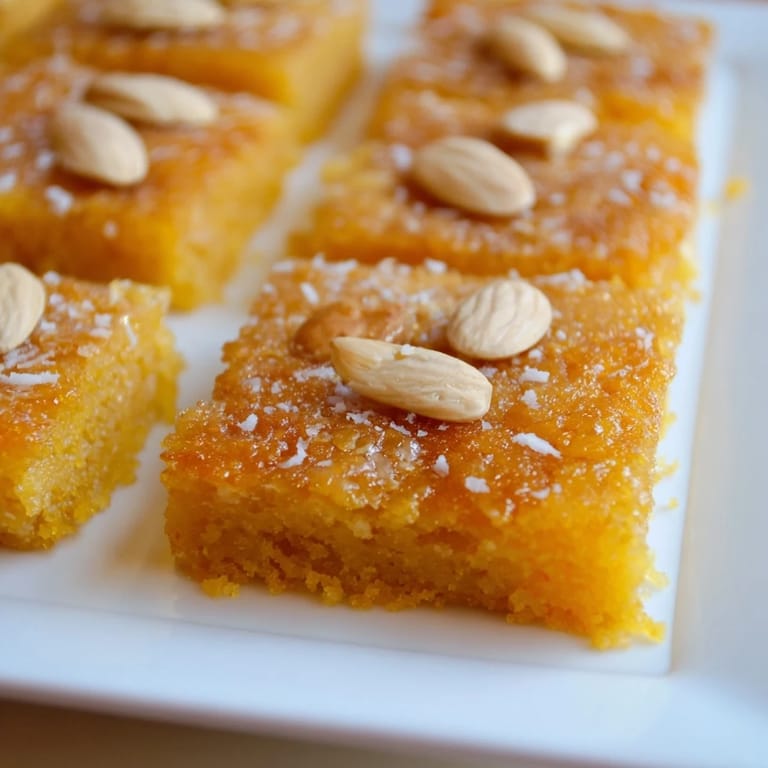
- The moment the basbousa comes out of the oven, pour the cooled syrup slowly and evenly over the entire surface, letting it soak into the scored lines. The contrast between the hot cake and cool syrup is part of the magic, and the syrup will seem to disappear as it's absorbed.
- Cool and serve:
- Let the basbousa cool completely at room temperature, then re-cut along the scored lines with a sharp, clean knife to separate the pieces. Serve at room temperature with mint tea or strong coffee.
 Save to Pinterest
 There's a moment, right after you pour that cool syrup over the hot cake and watch it vanish into the golden squares, when you realize this is why people gather around food. My daughter once asked why basbousa gets better when you wait a day, and the answer is that the syrup keeps seeping deeper, making the whole thing more cohesive and more itself. That patience, that transformation happening slowly in a covered container on the counter, feels like a small miracle.
The Syrup Is Everything
The syrup might seem like an afterthought—just something sweet to pour on—but it's actually the entire soul of basbousa. Without it, you have a pleasant but unremarkable semolina cake; with it, you have something that sticks to your fingers and your memory. The lemon juice is crucial because it keeps the syrup from being cloying, and the rose or orange blossom water, if you use it, adds a whisper of something floral that people can't quite identify but definitely love. This is why you make your own syrup rather than using honey or corn syrup—the clarity and balance matter.
Variations and Substitutions
I've made basbousa with pistachios instead of almonds, and it's equally lovely—slightly earthier and with that green surprise when you bite through. For extra richness, you can replace half the yogurt with sour cream, which deepens the crumb and adds a subtle tang that plays beautifully against all the sweetness. Some people sprinkle extra unsweetened coconut on top before baking, which creates a more pronounced coconut crust.
Serving and Storage
Basbousa is best served at room temperature with mint tea, strong black tea, or Turkish coffee—the bitterness of the tea is the perfect foil to the sweetness. Store it covered on the counter for up to 3 days; it actually improves as the syrup continues to distribute, so don't hesitate to make it ahead. If you have any left after that (which rarely happens in my house), cover it with plastic wrap and refrigerate for up to a week, though it's best eaten sooner.
- Serve with a small fork or toothpick because your fingers will get sticky, and that's part of the charm.
- If the cut pieces start to separate slightly during storage, that's normal and actually a sign the syrup has done its job.
- Bring it to room temperature before eating if it's been refrigerated, because cold mutes the flavor and texture.
 Save to Pinterest
 Every time I make basbousa, I'm grateful for that neighbor who walked over on an ordinary afternoon and showed me that some of the best things in a kitchen are also the simplest. This cake, with its moist crumb and sticky-fingered satisfaction, is proof that you don't need fancy ingredients or complicated steps to create something memorable and deeply comforting.